
WhatsApp’s long-standing claim of strong end-to-end encryption is once again under scrutiny following a new lawsuit against Meta Platforms and renewed criticism from prominent figures in the privacy and security community.
According to a report published by Forbes, an international group of plaintiffs alleges that Meta has the technical ability to store, analyze, and access WhatsApp users’ private communications — a claim Meta firmly denies.
Legal Challenge Targets Encryption Claims
The lawsuit argues that WhatsApp’s implementation of encryption does not provide the level of protection users are led to believe, pointing to metadata collection and server-side mechanisms as potential weak points.
While WhatsApp maintains that message contents remain inaccessible to the company, the case is fueling broader debate over how encryption is implemented in large, centralized messaging platforms.
Telegram Founder Issues Sharp Criticism
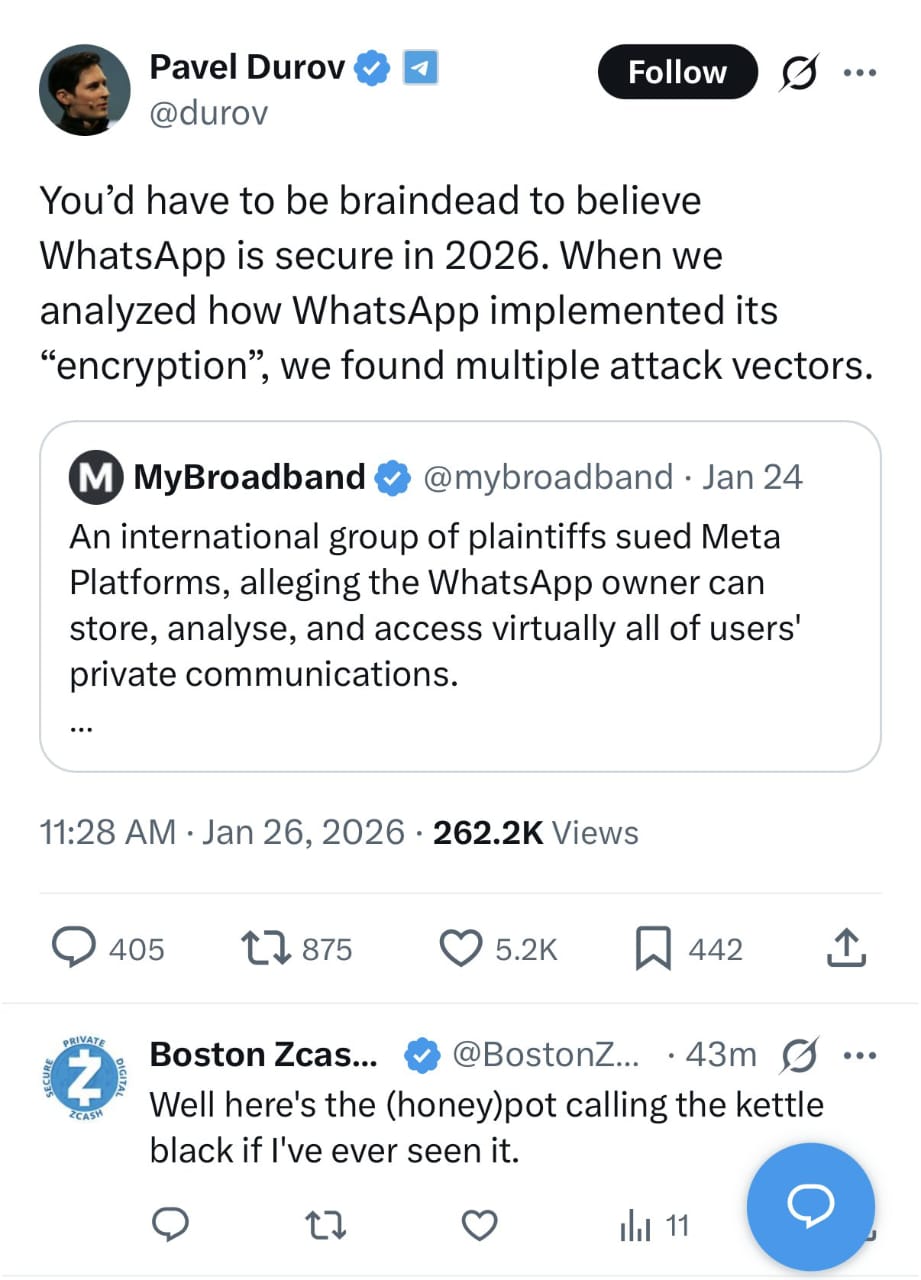
Telegram founder Pavel Durov publicly criticized WhatsApp’s security model, claiming that his team identified multiple attack vectors when analyzing WhatsApp’s encryption implementation.
Durov’s remarks quickly gained traction, amplifying long-running concerns about whether WhatsApp’s scale and integration with Meta’s infrastructure are compatible with strong privacy guarantees.
Elon Musk Weighs In
The dispute gained wider visibility after Elon Musk weighed in on the issue, resharing commentary related to the lawsuit on X. His post quickly amplified the discussion, exposing it to a global audience of millions.
Although brief and lacking technical detail, Musk’s comment added momentum to the ongoing debate around the security and trustworthiness of encrypted messaging platforms operating at massive scale.
His involvement further fueled skepticism surrounding WhatsApp’s privacy assurances, underscoring how even high-level public figures continue to question the robustness of mainstream end-to-end encryption claims.
Should Users Be Concerned?
At this stage, no definitive proof has been presented showing that WhatsApp is actively reading message content. However, the lawsuit and public criticism highlight the gap between marketing claims and the nuanced reality of modern encrypted messaging systems.
Privacy-conscious users may wish to reassess their threat model, consider alternatives, and remain cautious about how much sensitive information they share on any centralized platform.
Sources & References
This article was written for DigitalEscapeTools based on publicly available reporting and verified public statements.